Showing posts with label Civic Culture. Show all posts

Tuesday, December 22, 2009

Goo-goo Watch: Kevin McCrea

I've generally been of the opinion that good-government progressives should never be allowed in public without adult supervision, and this reinforces my point.:

When my campaign for Mayor was over, many people suggested I apply for the school committee and Mayor Menino had told me that he was interested in working with me, in particular in regards to our trade school in Boston.
The Boston School Committee is an appointed body for the specific purpose of  eliminating public scrutiny and input into local education (since education is secondary to the care and feeding of bureaucrats and teachers - in that order).  Nevertheless our brave reformer takes the Mayor at his word, and applies for one of two vacancies:

The applications were to be emailed to a Nancy Lo, who works for the City of Boston...
...I made a few calls and left messages to other members of the committee to try and find out if I had made the cut or not. During the course of the work day I heard back from a number of the people on the committee. They were all extremely nice, freely answered my questions and clearly were just citizens who were volunteering and doing their civic duty who had no idea what the rules laid out by the State Law were. They had all been on the committee for years, some up to 10 years. They all referred me back to Nancy Lo who clearly was the organizing and directing force of the committee...
One committee member told me that it is "not a fair process" and that committee members "dare not say anything" because if they disagree with Menino that they will soon be gone. I also took the time to look up Nancy Lo and found out that she has been with Menino for years, previously running the elections department and named by Boston Magazine as one of the most powerful women in Boston. She currently works for the Inspectional Services Department and makes more than $100,000 a year...
That evening I talked to my wife Clara who is infinitely smarter than I about what I should do about these types of things. I clearly could file an Open Meeting Lawsuit which if filed within 21 days of the December 10, 2009 non-public meeting would rescind the action the group took. But what was clear in speaking to the members of the committee is that there was no knowledge that anything they were doing was anything other than their civic duty, unlike the Boston City Council which was willfully trying to exclude the public from their decision making process. I didn't want to drag good, decent citizens into something not of their making. It seemed to make sense that since the Mayor hadn't made his final decision yet to just ask the committee to hold the process in accordance with the State Law.


The next morning, Friday, I called Dot Joyce again and let her know that I was now convinced that the Open Meeting Law had been violated, probably for at least a decade, but that I'd like to work with the administration to rectify the situation without wasting valuable time and resources. I asked her if she knew the person in charge of this: Nancy Lo. She said she had heard of her, but didn't think she had met her. I told her that I hadn't been able to get in touch with her, but perhaps she or the Mayor could get in touch with her, and let her know that the State Law had not been followed. I let her know I'd been working with the District Attorney on this matter as well.


I spoke with the District Attorney's office again and they agreed that a "do over" that followed the law was probably a reasonable thing to do since no final decision had been taken. They said they would confer and get in touch with the City.
Nancy Lo is one of the Mayor's enforcers, notorious for her contempt for legal and procedural niceties; but that's not the issue here.

The point is that Kevin McCrea, who ran for Mayor, and before that, City Councillor-at-Large could be so ignorant of the power dynamics of his own city government.

McCrea's concern about the lack of transparency and the Mayor's contempt for the Massachusetts Open Meeting Law ignores the fact that neither is a secret in Boston politics.   In fact there are no secrets in Boston politics.  Yes, the fix is in but anyone who cares to know can find out the specifics of the fix.  Given sufficient time and reasonable organizing skills, a fix can be upended.   Mayor Menino's organization is close to nonexistent; it depends upon two things: the political vacuum in the City and the disconnect between activists and the community.   What McCrea displayed in his search for political sainthood does nothing to advance anything beyond  his ego.  In and of itself insignificant, except that he actually has the resources to successfully advance his causes, given less narcissism on his part.

Until activists relearn the arts of political intelligence and precinct organizing, they will be no more than political suppression mechanisms, working on behalf of their opponents.  First and foremost of the preconditions for both is knowing what the hell is going on both in government and on the street.

Tuesday, December 01, 2009

How Massachusetts Became a No-Party State

In order to understand Massachusetts politics, one must come to terms with the State’s myths. Left and Right, Democrat and Republican, within and without Massachusetts, the misconceptions exist: Massachusetts as a liberal State; and Massachusetts as a one-party State.


Both are false.

Measured by the political attitudes of its citizens, Massachusetts is a center-right State. It is, however the center-right State with the highest percentage of liberals.

At the same time the organizational structure of statewide politics became so degraded as to be nonexistent. Despite the number of elected officials with parenthetical “D”s after their names, the Commonwealth is actually a no-party State.

Here’s how it happened.

Until the early Seventies, Massachusetts was competitive at the statewide level between the two Parties, with liberal Democrats contending with progressive Republicans.

A point of nomenclature: “Progressive” is not the same as “liberal”, political jargon notwithstanding. Liberal in the American sense of the term denotes a system based upon government insuring equal opportunity to insure upward social and economic mobility. “Progressive” in the same sense assumed public administration by an educated elite, based upon rational principles of management. The corruption of these terms (among others; neither the market fundamentalism nor the right-wing populism predominant in today’s Republican Party could be considered to be “conservative”) is one of the reasons for the ongoing collapse of the Commonwealth.

The political history of the Commonwealth of Massachusetts, in particular the Yankee versus Irish political wars of the nineteenth through mid-twentieth centuries added ethnic components to the class conflicts between the two Parties; nevertheless both were firmly anchored in the civic cultures of their respective adherents.

Then came the Sixties.

In hindsight, most of the damage was done, not by the New Left or the Counterculture, but by the New Politics wing of the Democratic Party. Combining the elitism of the Progressives with the class bigotry of traditional conservatives, and a tendency to condescending racism. New Democrats sought to dispense with grassroots politics altogether, preferring to concentrate on media campaigns, targeting educated suburban voters. Urban labor-liberals, though more numerous on the ground (and in the Legislature) soon lost control of the Massachusetts Democratic Party. Many, while remaining Democrats, became swing voters, casting their ballots for Republicans in national elections. Hence the strength of George Wallace in 1976; and Reagan winning Massachusetts in 1980 and 1984.

On the Republican side, old-style progressives fell victim to a “New Right” alliance of social conservatives, market fundamentalists, and libertarians; doing as much damage to the social culture of Massachusetts as their portside cousins.

Long story short: there were rebellions within both parties, middle-class good-government types (hereinafter “goo-goos) took over the Democrats; larval Reaganites took over the Republicans. A corruption of progressives in the original sense, goo-goos are too class bigoted to form lasting alliances with culturally working class voters. The Republicans (allied with the Libertarian Party) were victimized by their own success. A twenty-year process of successful grassroots organizing collapsed under the weight of narcissism at the top.

In the period from 1974 to 1978, both parties had collapsed as principled political mechanisms. The following three decades saw the collapse of grassroots politics. The result was a loose feudal system, centered upon state representative districts and strong mayors in cities like Boston and Worcester. Rather than the governor, power in such a system naturally accrues to legislative leadership, usually the Speaker of the House.

Hence, the operating premises of Massachusetts state politics, both ideological and structural are false. What exists is loosely corporatized feudalism in a collapsing polity, overwhelmed by its costs, and whose elites are too decadent to care.

Thursday, November 19, 2009

The Great Realignment: Taking back the grassroots

There was an interesting op-ed  in the New York Times yesterday, pointing out that Senate support or opposition to the Obama healthcare package has little to do with the merits (or lack thereof) of the plan.  The correlation is to Obama's personal popularity in the State a given Senator represents.

Consider, for instance, the 39 Democrats who voted against the bill in the House, which approved the health care bill by a margin of 220 to 215. According to data compiled by The New York Times, 31 of the 39 Democratic naysayers hail from districts that John McCain won last November. Although the upper chamber has a reputation for being less rigidly constrained by near-term political considerations, odds are that the same calculus will prevail in the Senate.
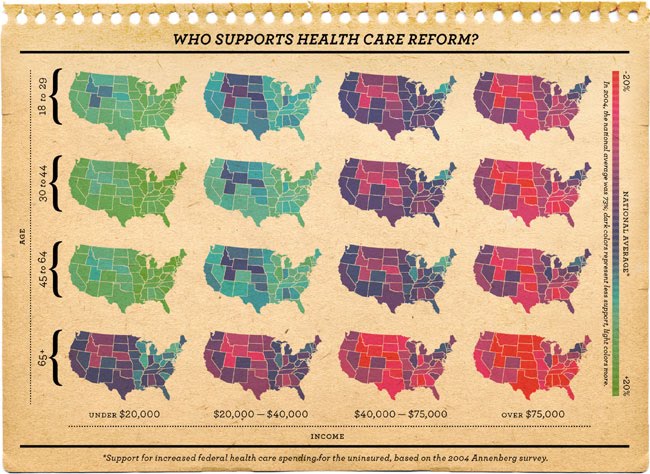
Thus the opinions of the electorate on health care are trumped by their feelings about Obama:


The authors sum up the dynamic:

Nowadays, President Obama enjoys higher approval ratings — in the low to mid-50s, according to most polls — than do the Democrats’ health care reform plans, which are mired in the mid-40s in most surveys. Conditions being what they are, Democrats would rather have a referendum on the president than one on the health care bill itself.


Still, what these numbers seem to reflect is a series of missed connections. On the one hand, there is a disconnect between Mr. Obama and the electorate: the president — who had popularity ratings in the 60s when the health care debate began — has generally stayed in the background during health care negotiations, leaving the unpopular Congress to be the public face of the bill.


On the other hand, there is a disconnect between the electorate and the 535 members of Congress, who seem to be so fixated on Mr. Obama’s standing in their states that they’ve paid little attention to what their constituents might want — or need.
This actually makes the problem solvable. Not so much by Obama, but by the national Democratic Party - in particular by its Blue Dog and Labor-liberal components.   Much if not most of what passes for conservatism in this country is populist anti-leftism.


Based upon cultural and geographical commonality the outreach would have to be done by an ideologically balanced organization anchored in civic culture and working on the basis of civic responsibility.

The effort would also have to be independent of Obama.

Quite frankly the various progressive activist groups (MoveOn, et al) and Obama's Organizing for America would be detrimental in such an effort. In the absence of campaign discipline, Obama's current volunteer operation is Howard Dean, redux, precisely the kind of dysfunctional operation recognized as counterproductive in 2008.

Thursday, November 05, 2009

Requiem for Floon

Another Boston election cycle is over and both the media and activist community do what they do best: misunderstand the obvious.

Given the abysmally low turnout, the race was Flaherty's to lose. And he lost.

As I predicted, here, here, here, and here, the alliance between Michael Flaherty and Sam Yoon was doomed to fail because the alliance was much less than the sum of its parts. This is unfortunate in a perverse sort of way because Boston needs a viable alternative to the current Administration. The Dog is not averse to tilting at the occasional windmill, and if either Flaherty or Yoon had shown any indication of being principled reformers, he would have been the first to hold their signs during rush hour.

On the plus sign, if I hadn't been so annoyed by the sheer incompetence of both the challengers and the media coverage thereof, I probably wouldn't have started blogging. (That's plus for me, dear reader, not you.)

At any rate this municipal election cycle was a textbook case study of political incompetence and journalistic misfeasance.  The media coverage of the race was so crappy that to call it incompetent would be a complement.  The Boston Globe in particular went through a consistent period of self-deluded Duh moments masquerading as political coverage. Menino has a short temper? Menino likes to micro-manage? Menino runs a closed Administration?  Spare me. He's been that way before he was even a District City Councillor.

And everybody with an IQ above single digits knows it.

What the media never covered is the fact that the Mayor's lack of articulation disguises arguably the best field brain of his generation of Democrats.  The rise of the "accidental Mayor" was never accidental; he had a comprehensive City-wide organization (put together, I might add, in plain sight) a good year before the 1993 election.  The only problem was and is the fact that the Mayor's electoral virtues are administrative vices.

The opinions of good-government progressives notwithstanding, campaigns aren't democracies, nor are they organized to further the common good.  Campaigns are about obtaining power.  Thus, a wining campaign manager is always aware of the shifting correlations of power.  The demands of the business thus present the danger that the inherent dispassion necessary to win can morph into cynicism.

In a functioning civic culture this danger is checked by informed and active citizens (and their elected representatives) at the local level.  But Boston's civic culture's been dysfunctional for decades, aided and abetted by an equally dysfunctional media.  There were (and are) no checks and balances in the system, and only a few at the neighborhood level, conspicuously the Dominican community and the West Roxbury neighborhood of the city.  Both communities are organized as civic units across class and ideological boundaries; hence Menino is always attentive to their needs. 

The City Council's power to limit Mayoral abuse by cutting the city budget is unexercised. Flaherty's accusations during the campaign were if anything understated.

The problem was that Flaherty never did squat to address those issues in nine years on the Council.

Yoon not only did nothing of substance on the Council; his reluctance to dirty his hands with constituent service work made him less than popular with his constituents.  Yoon's alliance with progressives ignored the fact that progressives are not seen as assets in black, Latino, and working-class white communities.  In the case of Boston's Dominican community, cited above, there has been a decade-long fight against white Jamaica Plain activists over developmental issues.  In Boston's black communities there are similar battles are fought. (The difference being that the better-organized Dominicans win their fights.)  Coupled with the profoundly incompetent advice he got from his consultatant, Yoon actively repelled those the media thought were his core supporters (Menino won Chinatown with twice Flaherty's vote.)

Hence, from where the Dog sits, there was never any doubt about the outcome.

The problem is that principled candidates, running competent campaigns could have easily won.

Saturday, October 17, 2009

Boston Political Reporting: Oxymoron or Urban Legend?

In order to thumbnail Boston's political reporting (more accurately the competent lack thereof), we need to look at the media business as a whole.


So please bear with me as the Dog goes didactic on y'all:

A continuing source of frustration to me is the structural disconnect between the media and day-to-day politics. It's nothing new; in fact, journalists and commentators such as William Greider, E.J. Dionne, and Kevin Phillips analysed the dynamic years ago.

American politics (and the journalists that report on it entered a period of structural cognitive dissonance forty years ago, from which they have yet to leave. It's inaccurate to look at this in terms of Left versus Right politics, since the New Left was neither new, nor a Left, and Reagan was not a conservative.

American elite culture became so disconnected from the broad base of society that politics, public policy, and civic culture, that many Americans presumed malicious intent to explain what was in fact structural collapse. This accrued to the benefit of the Republican Party; in its most sophisticated form, it accrued to the benefit of Richard Nixon, who realized that:

(a) the Left was useful as an outreach mechanism;

(b) that the Left as constituted had no politically significant constituency (there was no "Youth Movement", the biggest college organization in 1967 was the College Republicans, and white baby boomers have been a primarily Republican constituency since 1968);

(c) the New Politics movement within the Democratic Party, as symbolized by Eugene McCarthy was a Tory-Right dynamic, with its social culture derived primarily from the class bigotry of the 1950s Adlai Stevenson campaigns. The perfect metaphor for the period was McCarthy's 1980 endorsement of Ronald Reagan. What occurred (and is still occurring) is the triumph and commercial exploitation of class bigotry in American life.

While this approach was invented and refined by the Right, it's been an integral political tactic across the political spectrum, because small turnouts make for less heavy lifting by campaigns; and disengaged electorates are revenue enhancement mechanisms for the media side of the business.  Democrats have traditionally depended more on media than field (just as Democrats depend more on big contributions than Republicans), so it would be hypocritical to cast stones at elephants.

The decline in reporting paralleled the civic collapse, as print reporting became a profession, rather than a trade. Preconceived opinions became the basis of newsgathering in the absence of structural connections to the community. The myth of Watergate became the foundation for media amour propre, despite the fact that the Washington Post reporting had nothing to do with Nixon's resignation.

Television news became so consultant driven that infotainment and marketing (to be redundant) replaced journalistic values; and the same dynamic infected the print media, accelerating as competent reporters aged out of the business.

Corporate concentration within the media accelerated the process, but did not cause it; the problem is more the structural corruption of journalistic culture than the ownership thereof.

Put simply, the Sixties never ended.

In the modern world of politics, journalists exist primarily as conduits, so separate from reality that they do not know what questions to ask, much less whom to ask them. If pointed in the right direction, the media has sufficient resources to cover an issue in depth; but real-time political reporting at the local and State level is practically nonexistent.

Thus political players - and the term covers more than political professionals - have an inbred contempt for the media, and folks at the grassroots misconstrue arrogance and ignorance for conspiratorial malfeasance. The "corporate media'" and "liberal media" accusations from Left and Right are simply misinformed dogma resulting from the same thing.

A classic case in point is how the Boston Globe's coverage of Senator Dianne Wilkerson's tax problems in 1998 saved her seat. When the news first broke, community sentiment in Boston's black community was overwhelmingly negative until the Globe printed an op-ed by the Reverend Eugene Rivers condemning the Senator and calling for her resignation.

This ignored two dynamics hard-wired into Boston's black civic culture: most people hate Gene Rivers; and most people hate the Globe. In particular, the more prominent black Christian ministers and the Nation of Islam hated Rivers more than they hated each other. The result was a packed rally at the Charles Street AME Church, in support of a martyr of white racism, as symbolised by the genocidal cultural imperialists of Morrissey Boulevard.

Wilkerson was overwhelmingly re-elected.

Wilkerson's eventual defeat in 2008 actually reinforces the point.  Wilkerson was the Vice-Chair of the Senate Committee on Redistricting.  In that capacity, she redistricted more than forty per cent of the black population out of her District, while absorbing hostile populations in Back Bay and Jamaica Plain.  Her excuse that she was creating a "second District of Color" was demographically fraudulent, based as it was on raw numbers, not voting-age populations.  There was no media research of Wilkerson's premise, despite the fact that the data was easily available by Voter Tabulation District from the Census Bureau.

(In a related instance, the purjury conviction of then House Speaker Thomas Finneran was due, not to racism, but to his arrogance in protecting the electoral bases of incumbent representatives.  Had he been open about his motives, he would still be in office.)

Nothing has changed since then; hostility to the Globe is still a mainstay of black community politics. This is reinforced by the fact that there is no evidence of political literacy on the part of either of the Globe's black political columnists.

In a city such as Boston, where most of the politically germaine information exists in hardcopy minila files, Globe reporters are notorious for their belief that if it's not online, it doesn't exist. Their condescending behavior to low-level governmental staffers robs them of access to the only sources who really know what's going on. Their absence at neighborhood meetings makes them ignorant of neighborhood issues. Most importantly, their gullibility makes Globe reporters easy to spin.

The Boston Herald is by far the better of the two daily papers in terms of its political coverage, making up in sweat equity what it lacks in resources. The problems are that the comparitive poverty of the paper makes it subject to spin, and the vacuum in competent political reporting from the Herald's competators creates a culture of self-indulgence among some of its staff, particularly Howie Carr whose sources are the broadest in local journalism, but whose work too often slides into infantile ax-grinding.

The "alternative weekly" Boston Phoenix is essentially a corporate bohemian paper, with good media coverage, but nothing beyond recycled conventional wisdom and bad spin in its news.

The best journalism comes from the community and neighborhood newspapers, which, despite a tendency to boosterism, provide visibility to local political issues. As a rule of thumb: if you're working a local campaign in Boston, go to the Newspaper room of the Boston Public Library and read the local papers while ignoring the Globe. Let your campaign flacks work the dailies.